Doris Jacoby and her husband were driving the Northern State Parkway one day around 1950 with a baby only a few months old. On a whim they got off at Roslyn Road, one exit past their usual one. They found people waiting on a line and had no idea what it was for. As she told the Long Island Press in 2016, "Lo and behold, people [were] waiting to get into a model house." By the time they reached the salesman, only two houses were left out of 600.
One was a ranch on a single level. The other had a higher roof with enough attic space to add rooms later. The salesman talked them into the attic model, and Jacoby was still living in it 66 years later.
The houses on that line had something to sell beyond their floor plans. When Levitt & Sons first announced the development, in October 1949, it was already promising a club. The headline of the New York Times item from October 8, 1949, archived by the neighborhood history site, read "Levitt Assembles 400-Acre Site In Nassau County for 700 Homes," and its subhead said Levitt "Plans Country Club Facilities for Buyers of Houses at $17,500 Up." The club was in the pitch from the first announcement. The building at its center is older than any house on these streets, and it is still at 33 Club Drive, still hosting catered parties.
33 Club Drive was here first
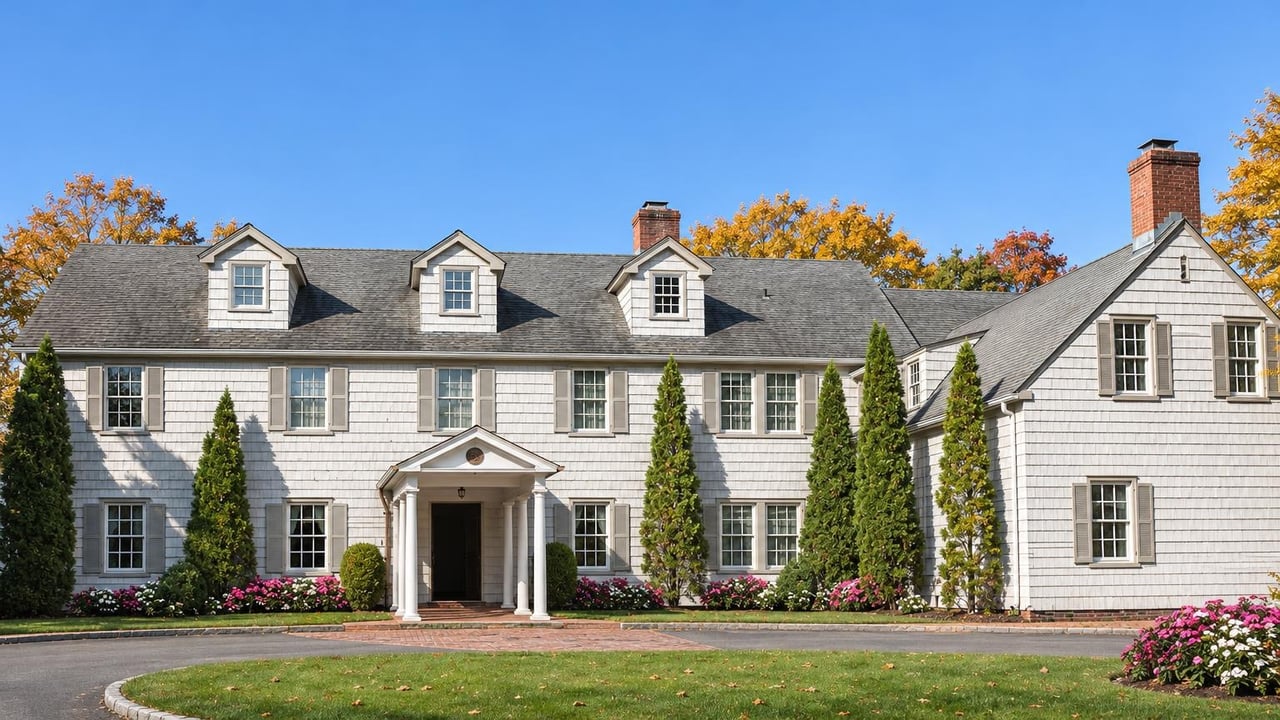
The mansion predates Levitt by three decades. Industrialist Edward Moore commissioned the estate house in 1918. It was finished in 1922, and he lived and entertained there for about 20 years. In the early 1950s the property became the Roslyn Country Club, and it hosted catered affairs for decades.
Today it runs as The Royalton Mansion, a wedding venue that still markets itself as being "At Roslyn Country Club." According to the venue's own history, the building had declined badly by the time Michael Einhorn acquired it, and he restored it to its 1920s appearance. So the oldest building in the Roslyn Country Club section is still doing the job it took on in the 1950s. If you live a few blocks away, the club your neighborhood is named for is a 1922 estate that people now rent for their weddings.
Levitt's 1949 announcement also said the tract included land from the Draper Estate, "Formerly in Old Westbury." Like much of the North Shore, this neighborhood began as estate country, and the Moore house is what remains of that era here.
What Levitt built around it
The plan announced in 1949 called for 700 homes. Later counts come out close to that: Newsday described the area as having "nearly 730" households in 2014, and as "a neighborhood with about 700 homes" in 2017.
Jacoby gave the Long Island Press a detailed account of what came with a house. Levitt built at least three models. Every lawn got a big evergreen, a maple and shrubbery, and she remembered his father driving through the neighborhood and calling out of his car to remind people to water. A dishwasher, refrigerator and washing machine came with the house, but no dryer, so some families kept theirs in the garage. Each house was painted a different color. Some had front entrances and some had side entrances, and some were low ranches while others had attics.
The layouts were open. Jacoby said her mother, on a visit, described the house as "like one big room." Jacoby compared the houses to Frank Lloyd Wright's and called the purchase "probably the best investment we ever made." Prices started at $17,500, and models with the larger attic cost roughly $20,000 to $21,000.
Some families put that attic to work quickly. A family who moved to 11 Clover Lane as some of the first residents later wrote that they finished theirs as a playroom. The family who bought that house in 1956 turned its attic crawl space into a bedroom and a photography darkroom, according to recollections collected on the neighborhood history site. If your home has a second floor tucked under a steep roofline, it may well have started this way. Our guide to architectural styles in Roslyn Heights covers how that housing stock has changed since.
The neighborhood also has a television connection. The Long Island Press reported that Bob Stevens, an early co-executive producer of The Wonder Years, and Winnie Holzman, one of its writers, both grew up here. The paper also passed along a local rumor that the show's Shepherd's Park was based on the playground across from Jacoby's house.
The club was where the neighborhood met
For the first few decades, the club worked as the neighborhood's shared living room. Jacoby told the Long Island Press that the civic association met at the club, that membership was limited to the community, and that it cost $100 a year. "We had meetings and dances and kids had Halloween parties," she said. She also remembered the pool as the place she met people "from the other sections... from the other side of the road."
Closed since 2007, and a decade of trying to reopen it
The neighborhood history site gives 2007 as the last year the club opened for residents. By 2014, Newsday reported, the club had been closed for eight years, and the roughly 10-acre site also held a catering business.
The Town of North Hempstead tried to reopen it as a public park. In December 2014, the Nassau County Planning Commission voted 7-0 to split off a 7.2-acre tract for the town to buy for $2 million. Under the plan, the town would fund a $14.2 million rebuild with a new main pool, a dedicated clubhouse, a food court, a basketball court and a playground. Construction was expected to start in 2015, with completion targeted for 2017. Residents would have paid an average of $800 to $1,000 a year toward the bond, and the rest of the site, including the catering business, would have stayed with its private owner. As late as March 2016, the Long Island Press wrote that the facilities should reopen in 2017.
The park was never built. The purchase did not close, and the deal ended effective January 1, 2015. The town took the matter to court in 2017, Newsday reported, and the case ended with an Appellate Division decision on January 25, 2023. Town spokesperson Gordon Tepper said in a statement, quoted on the neighborhood history site, that the town would "respect and abide by" the courts' decisions. Today the mansion is marketed as an event venue.
The houses changed while the club stood still
While the pool sat closed, the streets around it were being rebuilt. In 2016 the Long Island Press reported that a majority of the Levitt houses in the community were being knocked down and replaced with much larger homes. Jacoby, whose house had cost about $17,500 to $21,000, told the paper that the taxes on these homes had grown to roughly double what the original houses cost, and that "some of these houses cost $2 million." A later resident of 11 Clover Lane wrote that the new homes, at $2.5 million and up, had taken most of the trees Levitt planted.
On September 12, 2022, the neighborhood history site photographed one of the last original Levitt ranches as it came down, at 362 IU Willets Road. The house still had its television antenna. The post said few houses in original condition remain, though several still exist around the neighborhood, and it asked readers to send in addresses of original or near-original ranches so they could be photographed and added to a list.
Three pieces of the 1949 plan remain: the name on the map, the mansion on Club Drive, and a scattering of houses with Levitt's low rooflines among the rebuilt ones. Of the three, the 1922 house is both the oldest and the one in the most active use.
Seeing the 1950 neighborhood today
The easiest piece of the original plan to see is the mansion at 33 Club Drive, now operating as The Royalton. It is a private event venue, so the drive past is the visit for most people. If you've been to a wedding there, you've been inside the building the neighborhood is named for.
The surviving Levitt ranches take more looking. The neighborhood history site has the 1949 Times item, the original covenants and restrictions, and a January 1950 Good Housekeeping feature on the development. On a walk, you can spot the originals by their low single-story profiles and the steep attic roofs that Jacoby's salesman pitched.
For another nearby building whose history is easier to see from the road than from inside, our fall piece on the Roslyn Grist Mill restoration covers the other end of town. Our Roslyn Heights neighborhood page has more on the hamlet as a whole.
If your house in the Roslyn Country Club section still has its original Levitt bones, such as an expanded attic or a 1950 ranch footprint under later additions, we'd love to hear its story. Book a Consultation with Golden Real Estate Group and bring what you know about your house, from the original model to the rooms added over the decades.