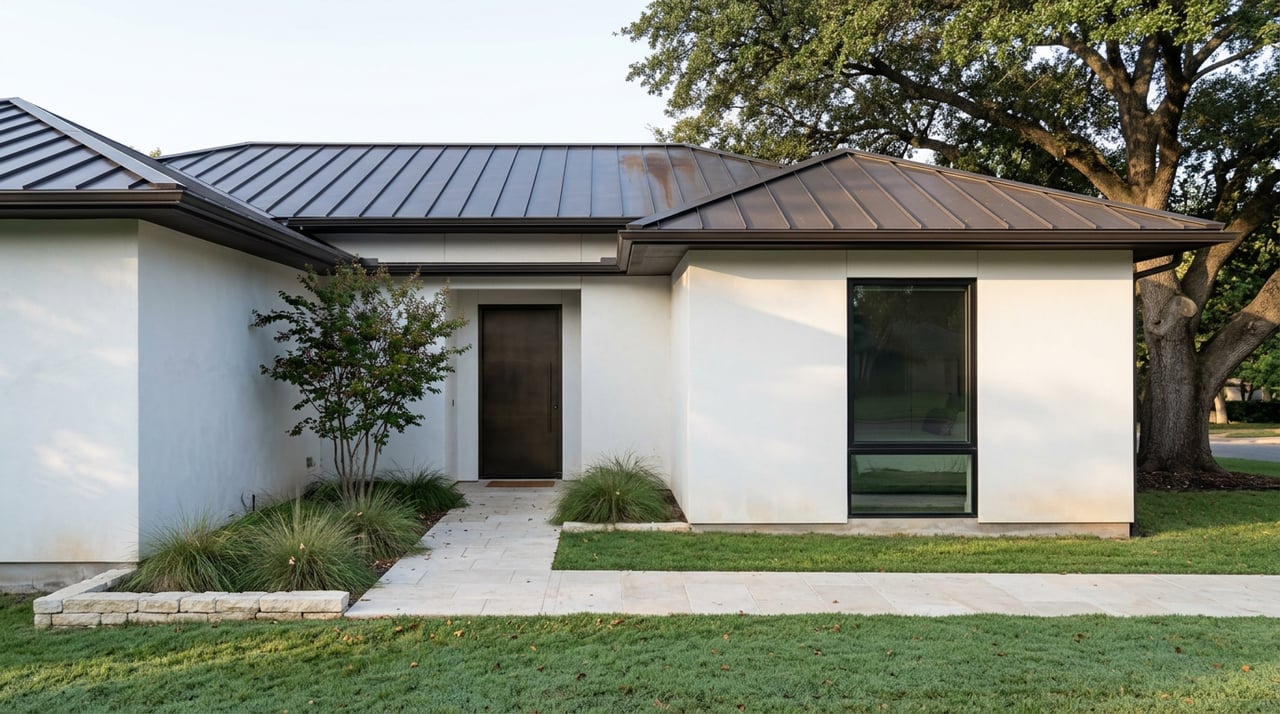
Two homes hit the market in Cedar Park on the same week last spring. Same list price. Same square footage. Same three-bedroom, two-bath layout a builder could have copied and pasted. The buyers who put offers on each expected roughly the same monthly payment once the loan closed.
They didn't get it. One escrow account came in noticeably higher than the other, and the gap had nothing to do with the mortgage rate, the insurance quote, or anything the listing photos showed. It came from a line most buyers don't ask about until the tax certificate lands in their inbox: the Municipal Utility District, or MUD.
What a MUD actually is, and why it exists at all
A MUD isn't a city department When a developer wants to build in an area that doesn't yet have water, sewer, or drainage infrastructure, the standard path in Central Texas is to petition the state to create a MUD. The district issues bonds to pay for that infrastructure, and homeowners inside the boundary repay the bonds through an annual tax, separate from the county rate, the school district rate, and the city rate.
That structure means the MUD line on a tax bill isn't fixed the way a city tax rate is. It's tied to a repayment schedule, and repayment schedules have a lifespan.
The rate is highest the year the subdivision is newest
Early in a development's life, the MUD carries the full weight of paying off recent construction bonds, split across however many homes have closed so far. That's why MUD rates on brand-new subdivisions commonly run 0.30 to 0.70 percent on top of the base combined tax rate. As more homes close and more of the bond gets retired, the burden per household shrinks and the rate drops with it. A district created with a rate around 0.55 percent can decline meaningfully within a decade, and eventually approach a much smaller fraction of that once most of the debt is paid down.
Some of the oldest districts in the Cedar Park-Leander corridor show what that looks like once the bonds are mostly retired. When a local outlet broke down district-by-district numbers back in 2019, Ranch at Cypress Creek and Williamson-Travis County MUD 1, two of the area's longest-standing districts, carried rates of $0.3425 and $0.4079 per $100 of value respectively, both lower than the surrounding city rate at the time. Those exact figures will have moved since, but the pattern they illustrate hasn't: age is the variable that matters, not the neighborhood's curb appeal.
Most MUDs also carry a second, smaller line for an Emergency Services District, typically somewhere around a dime per $100 of value, funding the fire and EMS response for homes outside full city coverage. It shows up on the same certificate, under a different name, and buyers who only budget for "the MUD" often miss it.
The rate can also disappear entirely
The most dramatic version of this mechanism isn't a slow decline. It's annexation. When a city annexes a MUD, the district's separate tax authority can be absorbed into the city's own utility system, and the standalone MUD line goes away.
Cedar Park has documentation of exactly this happening. The city's own annexation records compare the combined district and Emergency Services District taxes homeowners paid in Bella Vista MUD, and in the Williamson-Travis County Water Control and Improvement Districts 1F and 1G, against what those same homeowners paid to the city after annexation. According to the city's figures, many residents saw an overall decrease in their annual property taxes to local government once the switch happened. The comparison dates to a 2014 annexation, but it's a real, on-the-record example of a Cedar Park MUD tax line vanishing rather than just shrinking.
Where this maps onto the ground in Cedar Park
The mechanism explains something buyers notice anecdotally but rarely name correctly: older, established Cedar Park neighborhoods often carry a lighter effective tax load than newer ones at a comparable price point, and it's not because the city treats them differently. Pockets like Twin Creeks and Buttercup Creek are dominated by resale inventory built mostly between 2000 and 2015, meaning any MUD attached to those subdivisions has had time to retire some of its original bond debt. Newer construction pushing north and west along the 183A corridor, in communities like Crystal Falls and Travisso, sits inside districts that are still early in that same cycle, which is exactly where the 0.30 to 0.70 percent range tends to bite hardest.
None of this shows up cleanly on a listing sheet. A MUD tax line often reads as a flat annual number with no indication of which district it belongs to, how old that district is, or where it sits on the bond-payoff timeline. Two homes priced identically can carry genuinely different effective monthly costs, and the only way to know before writing an offer is to ask.
The MUD line is also just one moving part on a bill built from several independent taxing entities. Leander ISD, which covers Cedar Park, was weighing a bond package as large as $708.5 million for a possible November 2026 ballot when the district's facilities committee presented its recommendations this past summer, a reminder that the school district's rate can move on its own timeline, completely separate from whatever a given MUD is doing. The full tax bill is a stack, and every layer in that stack has its own clock.
What to ask for before you write an offer
- Request the full tax certificate broken out by taxing entity, not just the bottom-line annual total. A single combined number hides exactly the information you need.
- Ask when the MUD was created and where it sits in its bond repayment schedule. A district in year three looks very different from one in year twenty.
- Confirm whether an Emergency Services District tax applies on top of the MUD, since the two are often paired but listed separately.
- Ask whether annexation into the city is pending or has been discussed for that district. It's the one scenario where the tax line can disappear rather than just decline.
A few questions this raises
Is buying in a MUD a bad idea? Not inherently. MUDs finance the infrastructure that makes new subdivisions possible in the first place, and the rate you pay reflects that debt directly. The point isn't to avoid MUDs, it's to know which stage of the bond cycle you're buying into before you commit to a price.
Does every home in Cedar Park sit inside a MUD? No. Older, already-annexed parts of the city carry no separate MUD line at all. Whether a specific parcel is inside a district, and which one, depends entirely on when and how that section of the city was developed.
The takeaway
A Cedar Park list price tells you what a home costs to buy. It doesn't tell you what a home costs to keep, and the gap between those two numbers is often decided by a bond schedule you'll never see unless you ask for it directly. Our team pulls the full tax certificate, entity by entity, before any client compares two Cedar Park homes on price alone. If you're weighing subdivisions and want the real number behind the list price, Golden Real Estate Group is ready to walk through it with you. Book a Consultation and we'll break down exactly what you'd actually pay, not just what the sign says you would.
This article is general information, not legal, tax or financial advice. Consult a qualified professional about your situation.